SILAC RPMI 1640 不含有L-精氨酸,不含有L-赖氨酸,不含有L-谷氨酰胺,不含有酚红 ;用于多种同位素氨基酸标记实验
详细描述
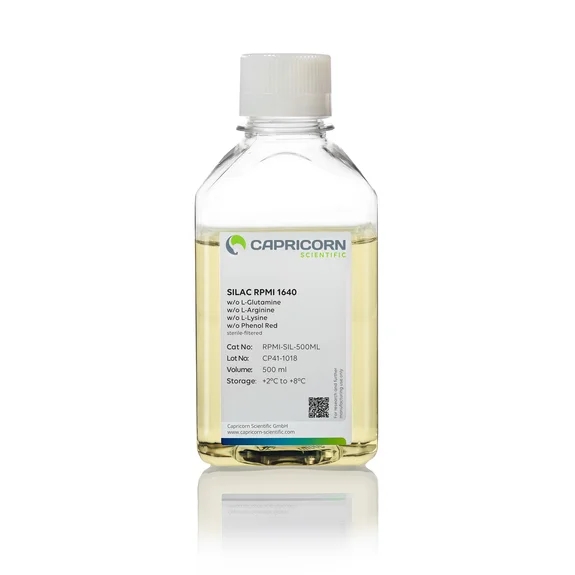
SILAC RPMI is optimized for labeling experiments involving the use of stable amino acid isotopes in cell culture to analyze protein expression by mass spectrometry (MS).
SILAC RPMI 培养基经过优化,适用于在细胞培养中使用稳定氨基酸同位素进行标记的实验,旨在通过质谱 (MS) 技术分析蛋白质表达。
Storage:+2°C to +8°C
Sterility:Sterile-filtered
产品描述
SILAC RPMI 1640 培养基,不含 L-精氨酸、L-赖氨酸、L-谷氨酰胺和酚红,专为涉及稳定氨基酸同位素使用的标记实验(SILAC = 细胞培养中氨基酸的稳定同位素标记)而优化。SILAC 技术为基于质谱 (MS) 的定量研究提供了一种简单、稳健且高效的方法,以探索蛋白质组的巨大复杂性。它被用于研究各个方面,例如蛋白质表达、蛋白质定量和蛋白质稳定性,这些通常是简单质谱分析难以检测的。
SILAC 标记是通过正常的代谢过程(例如细胞分裂)实现的,将非放射性的稳定氨基酸同位素掺入到新合成的蛋白质中。在此过程中,生长培养基中含有的"轻"氨基酸被"重"氨基酸取代。在这种培养基中生长的细胞摄取重氨基酸,从而能够区分轻蛋白和重蛋白。这些标记的靶蛋白也可用于蛋白质定量。蛋白质水平通过质谱仪根据信号强度进行测量(标记的细胞表现为更重)。通过提供定量的准确性和质谱结果解析的简便性,SILAC 方法为定量和功能蛋白质组学提供了独特的优势。
SILAC RPMI 的配方不含 L-精氨酸和 L-赖氨酸,适用于多种同位素氨基酸标记,且对细胞形态或生长速率没有影响。
应用领域:
- 定量与功能蛋白质组学
- 组织再生分析
- 翻译后修饰分析
- 质谱 (MS)
- 核磁共振 (NMR)
Description
SILAC RPMI 1640, w/o L-Arginine, w/o L-Lysine, w/o L-Glutamine, w/o Phenol Red is optimized for labeling experiments involving the use of stable amino acid isotopes (SILAC = stable isotope labeling with amino acids in cell culture). SILAC enables a simple, robust, and powerful approach in mass spectrometry (MS)-based quantitative research to explore the enormous complexity of the proteome. It is used to investigate various aspects, such as protein expression, protein quantification, and protein stability, which are difficult to detect with simple mass spectrometry.
SILAC labeling is accomplished via normal metabolic processes (e.g., cell division), by incorporating non-radioactive stable amino acid isotopes into newly synthesized proteins. In this process, the "light" amino acids contained in the growth medium are replaced by "heavy" ones. Cells growing in this medium take up the heavy amino acids and enable the differentiation between light and heavy proteins. These labeled target proteins can also be used for protein quantification. Protein levels are measured with a mass spectrometer, based on signal intensity (labeled cells appear heavier). By providing accuracy of quantification and the simplicity of interpreting MS results, the SILAC method offers unique advantages for quantitative and functional proteomics.
SILAC RPMI is formulated without L-arginine and L-lysine for multiple isotopic amino acid labeling and has no effect on cell morphology or growth rates.
Applications:
- Quantitative and functional proteomics
- Analyses of tissue regeneration
- Analyses of post-translational modifications
- MS (Mass Spectrometry)
- NMR (Nuclear Magnetic Resonance)

